Regular bodywork helps maintain well-being and enhance performance.
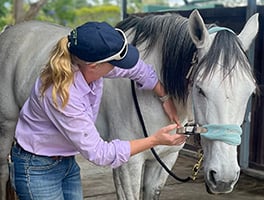
Nicola is certified in The Masterson Method® Integrated Equine Performance Bodywork, a gentle approach designed to release tension and improve your horse’s well-being. Horses naturally hide discomfort, and changes in behaviour - sometimes mistaken for misbehaviour - are often their only way of showing growing tension.
Each session begins with a consultation covering your horse’s age, work level, health, and any performance concerns, followed by a hands-on evaluation. Treatments are individually tailored and typically last 1 to 1.5 hours.
For best results, horses should be clean and dry, relaxed, and, if needed, have a familiar companion nearby. Allowing them to move freely after the session enhances the benefits, which is why Nicola prefers to work at your location.
You will receive feedback and any follow-up suggestions after the session.
*Nicola is not a veterinarian and cannot provide medical diagnoses, but she works collaboratively with your professional equine team, including your vet and farrier, to achieve the best outcomes for your horse.
Masterson Method®
Bodywork Treatment - $100
plus Travel - $20 per property
Contact us to discuss how The Masterson Method® can help your horse.
The Masterson Method® is an innovative form of equine bodywork that allows the horse to release deep, accumulated pain and tension in muscles and connective tissue. The use of light touch and gentle movement in a relaxed state, and observation of a range of the horse’s responses, leads to improved health and performance while enhancing communication between human and horse.
The Masterson Method® is an interactive method of bodywork in which we use subtle changes in body language to get not-so-subtle results. By applying levels of pressure (touch) and movement to the horse’s body in a way that the horse’s nervous system is unable to brace against or guard- and reading changes in the horse’s behavior as you do this – you enable the horse to tell you where it is holding tension; you enable her nervous system to release it; and you enable her to tell you when it has been released.
That part of the horse’s nervous system that blocks out pain and discomfort (the sympathetic, or flight, fight or freeze) lets go, and that part of the nervous system that regenerates and heals (the parasympathetic) comes into play. This allows the horse to release tension that it has difficulty releasing on its own.
Horses are survival animals. They instinctively mask pain and discomfort in order to stay alive and off the predator’s menu in the wild. This is how the horse is able to push so hard, often beyond its normal physical limitations, to do what is being asked of it. When the horse tries to communicate that it is uncomfortable or unable to do what is being asked, it’s often interpreted as a behavioural or training issue and is corrected or trained through by the rider. And the horse continues to work through the pain. This accumulation of tension takes its toll over time as deeper core and postural muscles begin to tighten to compensate for pain, or to take over for the muscles that are unable to do their job.
The horse communicates almost entirely through body language; from the most subtle level to the most obvious. Most of the horse’s body language is missed by us.
Watching Nicola work with Mikey was an absolute treat for both of us. Her quiet strength and gentle approach instilled confidence from the start, and it was beautiful to watch him relax and trust so quickly. I also really appreciated the safe space she created for me to be able to ask any questions that came to mind without fear of judgement so I could comfortably learn what I needed to know.
I will certainly be booking more time with her any time she is in the South Island and to the lucky people who have her in the Taranaki area, booking time with Nicola will be one of the best investments you can make!!
Sharron
South Island, New Zealand
Downloaded over 27,000 times. Now 10X Faster to Customize!